Queer Places:
17 Berkeley St, London W1J 8EA, UK
21 Manchester St, London W1U 4DJ, UK
Burnham Wood, 102 Harmer Green Ln, Welwyn AL6 0ES, UK
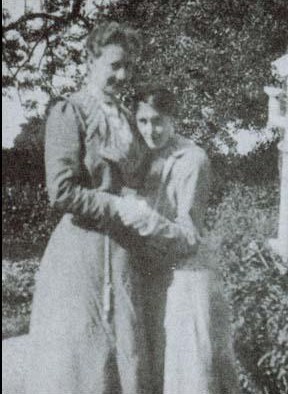 Mary Violet Dickinson (April 24, 1865, Frome, Somerset, England – 1948, Hatfield, Hertfordshire, England) was a central figure in the early adult life of Virginia Woolf. An unconventional and
supportive mentor, she played a vital role in Woolf’s development during a period of immense personal loss and creative transition.
Mary Violet Dickinson (April 24, 1865, Frome, Somerset, England – 1948, Hatfield, Hertfordshire, England) was a central figure in the early adult life of Virginia Woolf. An unconventional and
supportive mentor, she played a vital role in Woolf’s development during a period of immense personal loss and creative transition.
Born in Frome, England, in 1865, Violet was the daughter of Edmund Henry Dickinson and Emily Dulelbelia, and the great-niece of the Bishop of Bath and Wells. She belonged to a respectable,
well-connected family and served as the Mayoress of Bath from 1899 to 1900.
Standing at six feet two inches tall, she was famously striking in appearance. Though she often referred to herself as "plain," she was widely admired for her
intellect, humor, and "brisk common sense." She was known as a woman of generous spirit who moved easily through aristocratic social circles.
Violet met the Stephen family (including Virginia) in 1897. She became particularly close to Virginia in 1902, following the death of Virginia's sister,
Stella Duckworth. For years, she acted as a caretaker and confidante, frequently hosting the Stephen siblings, traveling with them, and providing emotional support
during the deaths of their father, Leslie Stephen, and brother, Thoby.
Violet was far more than a social companion; she was a significant intellectual and professional catalyst for the young Virginia:
She encouraged Virginia’s literary ambitions and served as a crucial sounding board for her early ideas about writing and life.
Violet used her connections to help launch Virginia’s career, introducing her to editors at publications like The Guardian, which led to Virginia's first
professional writing opportunities.
In 1907, a 25-year-old Woolf wrote a whimsical, three-part "mock-biography" titled The Life of Violet. The stories featured a version of Dickinson as a giantess who
defied societal conventions, built her own cottage, and traveled to Japan to spark a social revolution. This work is now seen as a precursor to themes found in Woolf’s
later masterpieces, such as Orlando and A Room of One's Own.
Following Virginia’s marriage to Leonard Woolf in 1912, the two women saw each other less frequently, though they maintained a regular, intimate correspondence for
the rest of their lives. Upon her death in 1948, it was discovered that Virginia had kept their letters, while, at Virginia's request, her own letters to Violet were
destroyed.
Violet Dickinson remains a key figure for Woolf scholars, as her influence—and the complex, sometimes playfully erotic nature of their early friendship—provides
essential context for understanding the emotional and artistic foundations of Virginia Woolf’s work.
References:
Other references:
- https://www.theguardian.com/books/2025/sep/27/a-cottage-of-ones-own-newly-unearthed-virginia-woolf-stories-to-be-published
- https://spartacus-educational.com/JdickensonV.htm
- https://artsci.utk.edu/ut-professor-shines-light-on-virginia-woolf/
- https://www.journals.uchicago.edu/doi/full/10.1086/740174
- https://bloggingwoolf.org/tag/violet-dickinson/
- https://www.rizzolibookstore.com/product/life-violet-three-early-stories
- https://theamericanreader.com/11-april-1913-virginia-woolf-to-violet-dickinson/
Support this project
This website is a passion project researched, developed, and funded entirely by me. If you find the content valuable and would like to help support the ongoing research and hosting costs, any contribution is deeply appreciated.
Thank you for keeping this independent resource alive!
My books on Amazon: Elisa Rolle's books
BACK TO HOME PAGE
